CASE STUDY · FINTECH

Expense management,
without the exposure.

CredX is a premium enterprise fintech platform designed to simplify employee expenses while keeping identities, transactions and payment information private by design.

Internal enterprise expense management · Privacy-first · Role-based UX

CredXAB
FINANCE OVERVIEWWhat needs your attention?
Total expenses₹12.8L↑ 8.4% this month
Pending review246 need attention
Policy exceptions07Review required
Spending overviewLast 6 months
Pending approvalBusiness travel · ₹18,450Policy compliant · Receipt attached

The dashboard prioritizes decisions over unnecessary personal detail.

01 / Overview

A private, policy-driven expense ecosystem for enterprises.

Managing employee expenses can become complicated quickly. Employees need a simple way to submit and track expenses, while managers, finance teams and administrators need approvals, policy enforcement and reporting.

CredX bridges those needs in one centralized environment. The platform manages approved expenses such as business travel, meals, corporate events, client meetings, transportation and accommodation.

Private by designExpose sensitive information only when a role needs it.
Policy-drivenBring limits and requirements into the workflow.
Role-basedDesign around employees, managers, finance and admins.
Action-orientedMake dashboards answer what needs attention.

02 / The challenge

How do you create transparency without compromising privacy?

CLIENT REQUIREMENTEmployee and payment information must remain highly confidential.

Privacy was not treated as a secondary security feature. It became a core product principle shaping information architecture, role permissions and the amount of detail visible on every screen.

01

Sensitive financial information

Protect payment and reimbursement information from unnecessary exposure.

02

Multiple stakeholders

Give each role the right level of access and context.

03

Complex policies

Support different limits, eligibility rules and approval requirements.

04

Manual processes

Move expense tracking away from fragmented spreadsheets, emails and receipts.

05

Lack of visibility

Give finance useful organizational insights without exposing personal data.

03 / The problem

The UX problem wasn't just submitting an expense.

“How can we give every stakeholder the information they need—without revealing information they don't need?”

The experience needed to reduce uncertainty for employees, speed up manager approvals, simplify financial review and give administrators control over policies and permissions.

EMPLOYEE

Clarity before submission

Understand eligibility, limits, documentation and approval status.

MANAGER

Focused approvals

Scan policy status, purpose and documentation without unnecessary detail.

FINANCE

Organizational visibility

Monitor categories, exceptions, reimbursements and spending trends.

ADMIN

Policy control

Configure categories, limits, eligibility, workflows and permissions.

04 / The solution

Four principles shaped the product.

01

Privacy by Design

Sensitive employee and payment information is exposed only to authorized users through role-based access and progressive disclosure.

02

Policy-Driven Spending

Eligibility, limits, required documents and approval workflows appear at the moment they matter.

03

Role-Based Experiences

Employees, managers, finance and administrators receive different experiences instead of one overloaded dashboard.

04

Intelligent Information Hierarchy

The UI prioritizes “What do I need to know?” before “What information is available?”

05 / My role

Senior UI/UX Designer

I was responsible for the end-to-end UX and UI design of the CredX platform.

Product discovery

Discovery, UX strategy, requirements and role definition.

UX architecture

User flows, sitemap, information architecture and role-based journeys.

Interface design

Dashboards, workflows, high-fidelity UI and responsive layouts.

Design system

Components, states, typography, colors and reusable patterns.

Prototyping

Interaction design, usability refinement and product flows.

Developer handoff

Responsive specifications and implementation-ready UI decisions.

FigmaFigJam

06 / Understanding the user

Four users. Four different jobs.

01

Employee

Goal: Submit and track expenses quickly.
  • Is this expense allowed?
  • How much can I spend?
  • What documentation is required?
  • Has my expense been approved?
  • When will reimbursement happen?
02

Manager

Goal: Approve legitimate expenses quickly.
  • Is this within policy?
  • Does approval need attention?
  • What information can I review?
03

Finance

Goal: Maintain financial control.
  • How much is the organization spending?
  • Which categories are increasing?
  • Which expenses require review?
04

Administrator

Goal: Control the expense ecosystem.
  • Which policies are active?
  • Who can access what?
  • What are the spending limits?
  • Which workflows are configured?

07 / Key user pain points

Designing around the moments that create friction.

01Policy uncertaintyEmployees don't know whether an expense is eligible before spending.
02Complex approvalsMultiple approval layers can make expense management slow.
03Excessive informationToo much financial or employee information creates privacy concerns.
04Manual trackingTeams spend unnecessary time following requests.
05Poor status visibilityDraft → Submitted → Under Review → Approved → Reimbursed.
06Lack of personalizationDifferent roles require different information.

08 / Design goals

Seven decisions that kept the experience focused.

01

Privacy First

Minimize exposure of employee and payment information.

02

Simple Submission

Reduce the number of steps required to submit an expense.

03

Clear Policy Guidance

Show policy information at the moment it matters.

04

Role-Based Visibility

Show only information relevant to the user's role.

05

Action-Oriented Dashboards

Every dashboard should answer: What needs my attention?

06

Financial Clarity

Use clear charts, categories, statuses and summaries.

07

Scalable Design

Support new categories, policies, roles and workflows.

09 / Product flows

From first action to reimbursement.

01Login

Secure, minimal and role-aware authentication.

02Choose expense

Travel, meals, events, transport or other.

03Submit

Enter details and upload supporting documents.

04Policy review

Communicate eligibility and limits before submission.

05Approval

Manager reviews focused information and takes action.

06Reimbursed

Employee tracks status without unnecessary payment detail.

DraftSubmittedUnder ReviewApprovedReimbursed

10 / Key screens

Designed around real enterprise tasks.

The CredX screens are presented inside an iPhone 16-style frame. Long screens remain fully usable through vertical scrolling inside each device viewport.
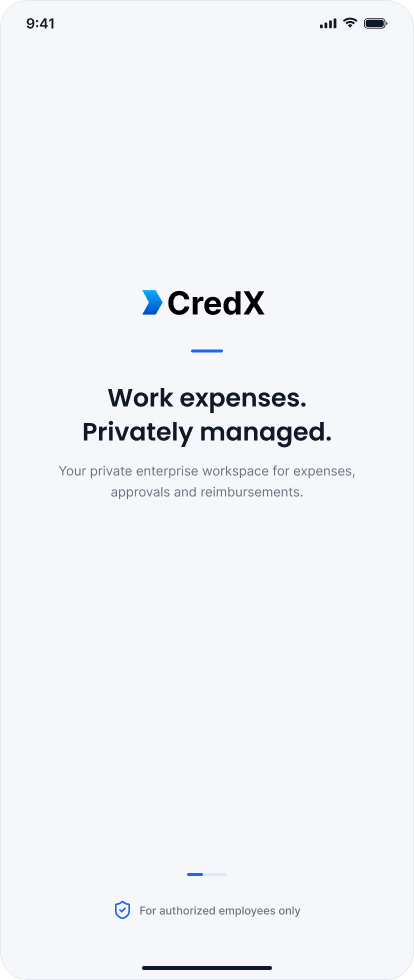
CredX splash screen
Splash screenFirst brand and product touchpoint.
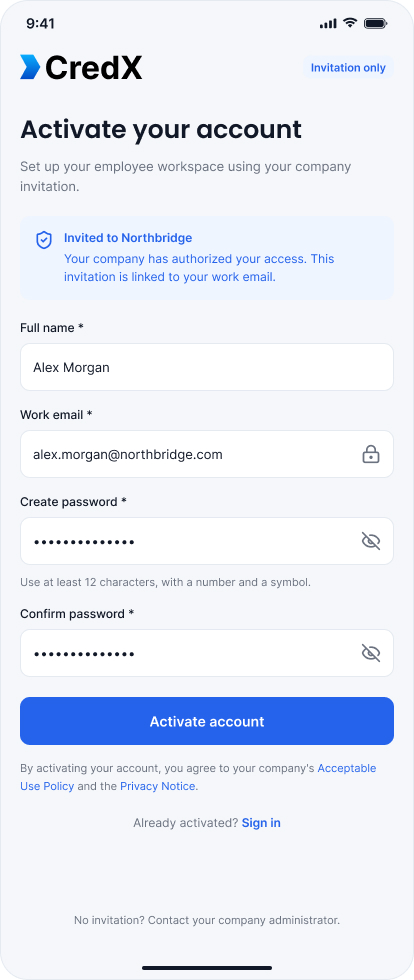
CredX registration screen
RegistrationAccount setup for enterprise users.
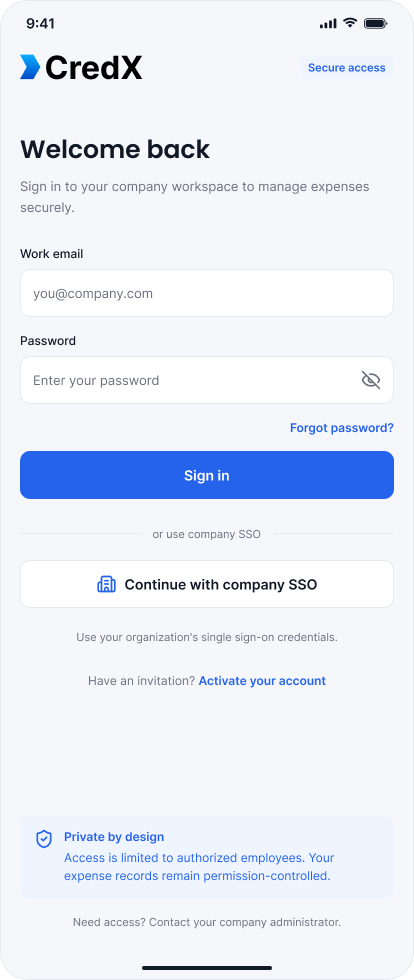
CredX login screen
LoginSecure entry into the role-based experience.
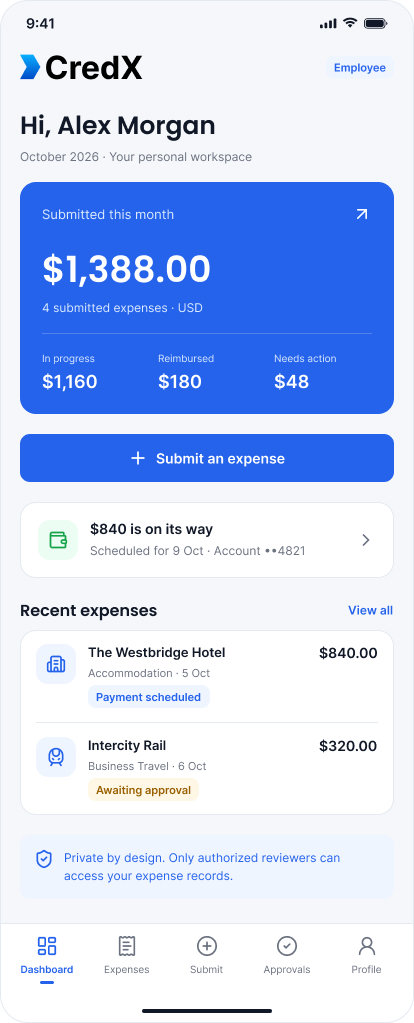
CredX employee dashboard
Employee dashboardOverview of expenses, approvals and reimbursement status.
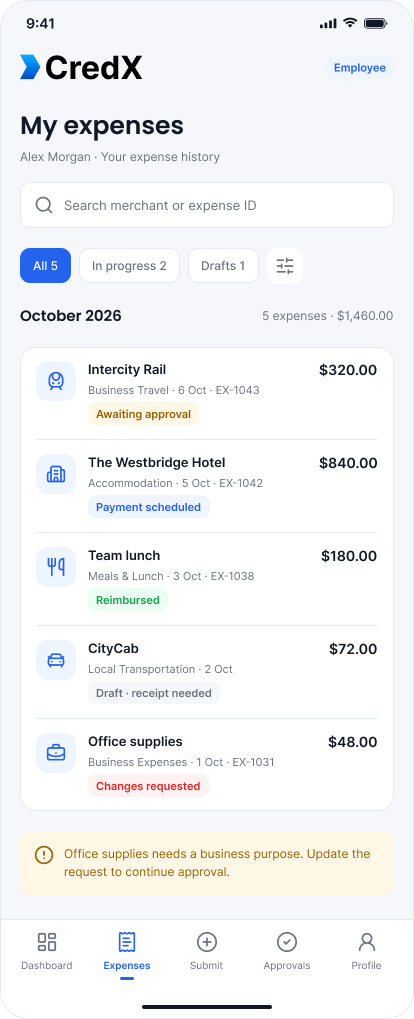
CredX expenses list
Expenses listStructured view of submitted and tracked expenses.
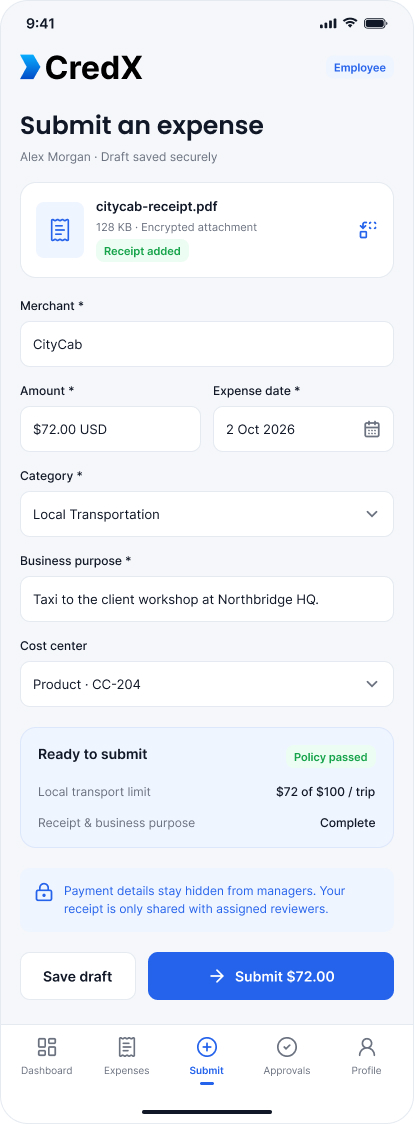
CredX submit expense screen
Submit expenseCapture the information needed to submit an expense.
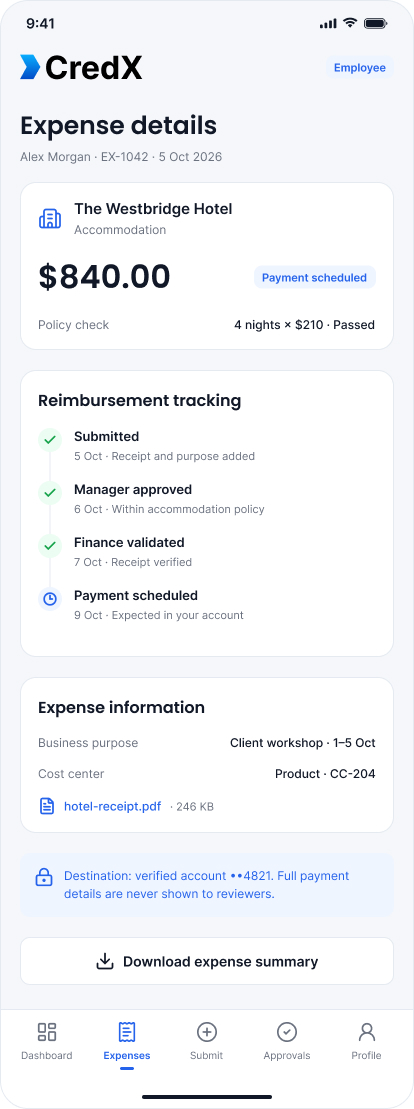
CredX expense detail and reimbursement screen
Expense detail & reimbursementTrack the expense through review and reimbursement.
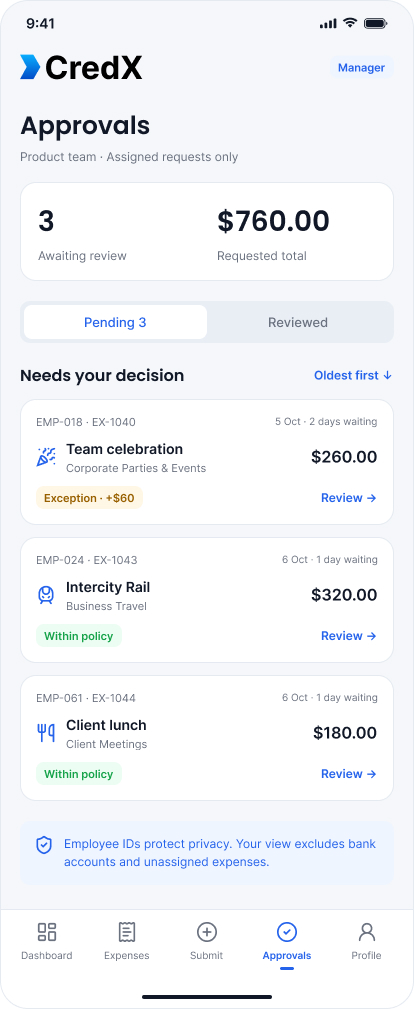
CredX manager approvals queue
Manager approvals queuePrioritize pending decisions without unnecessary detail.
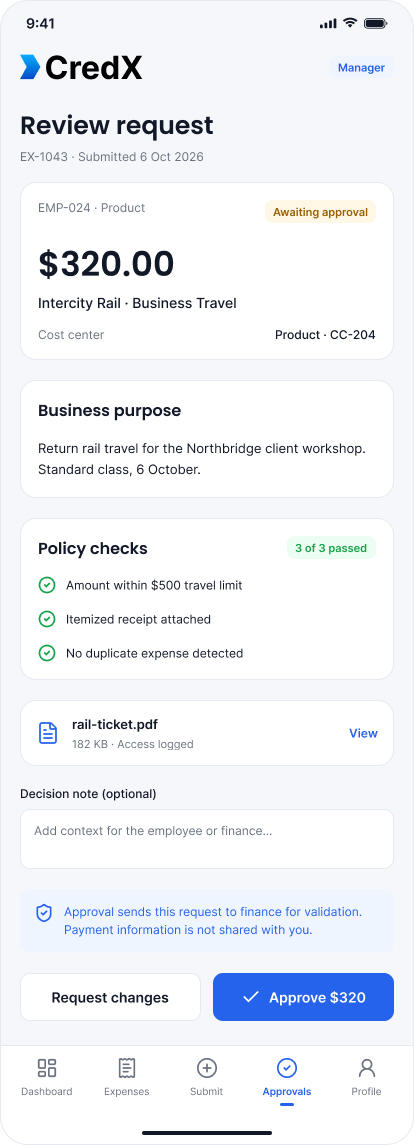
CredX approval review screen
Approval reviewReview policy context and take action.
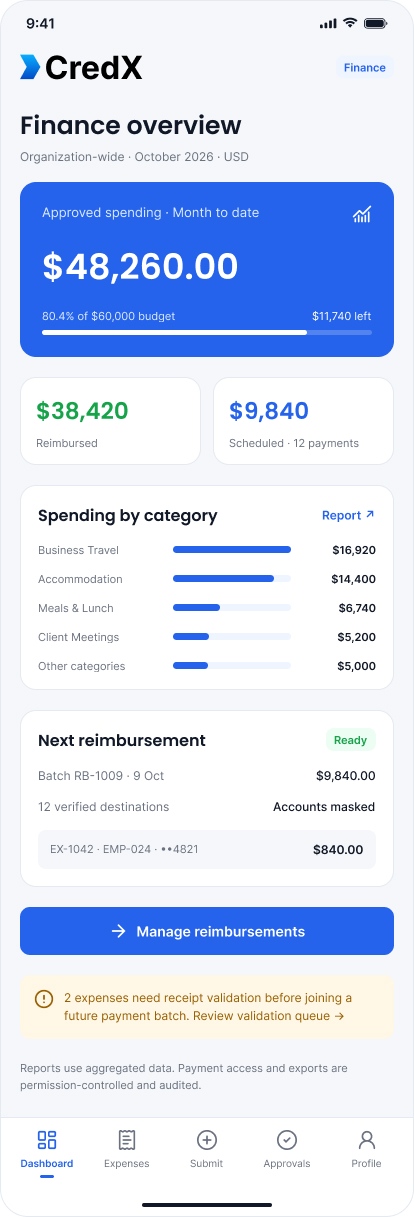
CredX finance spending and reimbursements dashboard
Finance spending & reimbursementsOrganizational-level spending visibility.
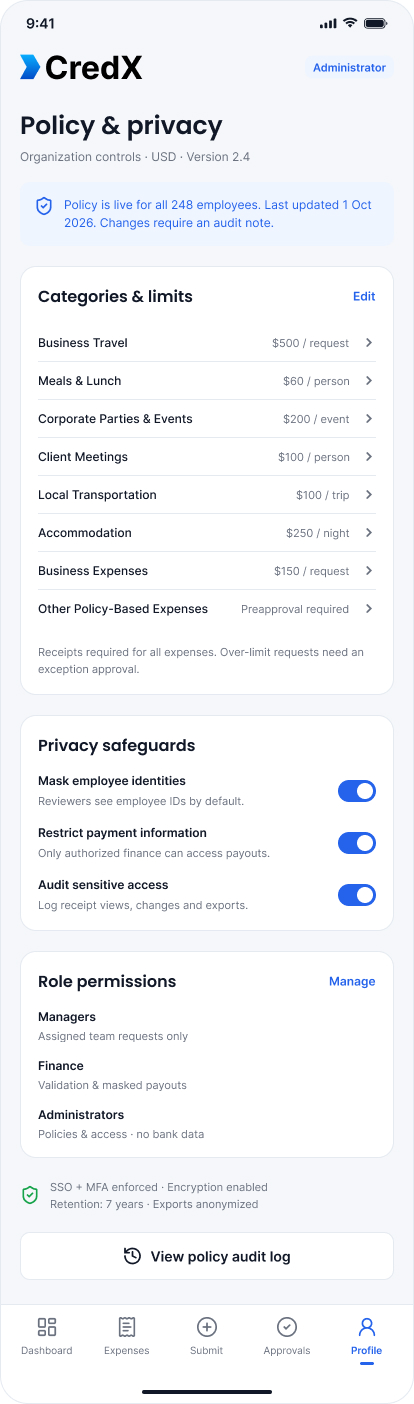
CredX administrator policy and privacy screen
Administrator policy & privacyControl policies, permissions and sensitive information exposure.

11 / Design system

Fintech precision meets enterprise trust.

InterH1 32–40px · H2 24–28px · H3 18–20px · Body 14–16px · Caption 12–13px
ButtonsInputsTablesCardsChartsStatus badgesSidebarTabsToastsAlerts

12 / Result

From expense tracking to a privacy-first financial ecosystem.

01Better privacy

Employee and payment information is surfaced according to role and permission.

02Simplified employee experience

Employees can understand policies, submit expenses and track status from one platform.

03Faster approvals

Managers receive focused information and clear actions.

04Better financial visibility

Finance teams gain organizational-level insights through dashboards and analytics.

05Stronger policy compliance

Expense policies become part of the product experience.

06Scalable architecture

The design system can grow with categories, policies, roles and workflows.

Final takeaway

CredX wasn't designed to expose more financial information.

It was designed to expose the right information to the right person at the right time.

Simple for employees. Powerful for finance. Private by design.